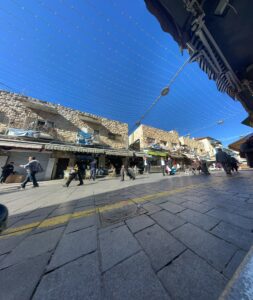
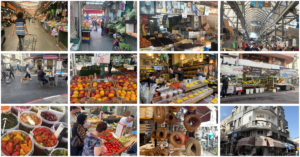
Levinsky Market, tucked in Tel Aviv’s Florentin neighborhood, has been a hub of spices, flavors, and immigrant stories for over a century.
The 1920s: A Planned Beginning
The story begins in the 1920s with urban planning. After the 1921 Jaffa riots, Tel Aviv needed its own commercial district, independent from neighboring Jaffa. In 1921, architect Yosef Tishler designed the Neve Sha’anan neighborhood with streets arranged in a menorah shape, placing Levinsky Street as the central axis.
By 1923, the area was becoming Tel Aviv’s first dedicated commercial center. The street was named after Elhanan Leib Lewinsky, a Russian-Jewish Zionist writer.
The Sephardic Foundation
The market’s character was shaped by immigrants from Thessaloniki (Salonika), Greece. After a devastating 1917 fire destroyed their Jewish quarter, many Sephardic Jews eventually came to Palestine. In 1924, the Salonika-Palestine Investment Company purchased land to build the Florentin neighborhood specifically for these working-class immigrants.
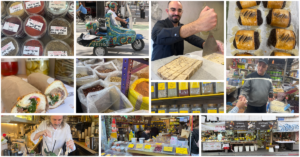
These Greek, Turkish, Bulgarian, and Balkan Jews opened the first shops on Levinsky Street in the late 1920s and 1930s. They brought their culinary traditions. Spices, dried fruits, nuts, bourekas, pickled vegetables, and delicacies from home. The street became a sensory experience where Ladino, Greek, and Turkish mingled with Hebrew, and the aroma of coffee and spices filled the air.
The 1940s-1950s: Holocaust Survivors Rebuild
After World War II, Holocaust survivors arrived and opened shops in the market. These weren’t just businesses, they were acts of rebuilding and remembering. Survivors from Greece, Poland, and across Europe brought both their culinary expertise and their stories of resilience.
Through the 1950s and 1960s, Levinsky Market thrived as a neighborhood essential. Working-class families shopped here for basics at affordable prices, while the merchants – now in their second generation – maintained their family traditions.
The Decline Years
Like many traditional markets, Levinsky struggled from the 1980s through early 2000s. Supermarkets drew customers away, neighborhoods changed, and foot traffic declined. Many longtime businesses closed. The market seemed destined to become another casualty of urban modernization.
The Revival
Around 2010, something shifted. Young people discovered Florentin’s affordable rents and bohemian character. Artists, cafés, and galleries moved in. Suddenly, Levinsky Market sat at the heart of one of Tel Aviv’s trendiest neighborhoods.
Food tourism brought new attention. Tours through the market became standard Tel Aviv experiences. International food writers discovered the spice shops and traditional eateries. A new generation of food entrepreneurs opened businesses alongside the veteran merchants.
Why It Matters
Levinsky Market embodies over a century of Jewish immigration to Tel Aviv. From Sephardic refugees rebuilding after fire, to Holocaust survivors starting over, to Persian Jews fleeing revolution, to young Israelis preserving tradition – the market has absorbed wave after wave of newcomers, each adding their flavors to the mix.
Today, it remains a working marketplace where locals shop for daily needs while visitors discover authentic Israeli food culture. The same family businesses that opened in the 1930s and 1940s continue operating, now run by grandchildren and great-grandchildren of the founders.
In an era of food halls and Instagram experiences, Levinsky Market stays defiantly real-a place where history lives in every sack of spices and every handmade pastry.
A century after its founding, Levinsky Market continues to prove that the best way to preserve culture is to keep it alive, messy, authentic, and open for business.
Harry Rubenstein is a pastry chef, food guide, and Jewish food expert based in Israel. A graduate of Bishulim Culinary Institute, he leads private food tours through Mahane Yehuda in Jerusalem and Levinsky Market in Tel Aviv. His writing on Jewish food history appears in The Nosher.
Read more about Harry →