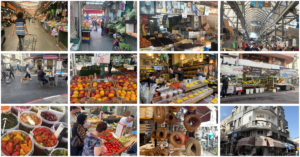
The aroma of freshly ground coffee, the sound of Ladino echoing from a delicatessen counter, the sight of hand-rolled bourekas cooling on a baker’s rack. These sensory markers of Levinsky Market tell a story that begins not in Tel Aviv, but in a burning city across the Mediterranean Sea. To understand why Levinsky Market tastes, sounds, and feels the way it does, you must first travel back to August 1917, to Thessaloniki, Greece, where a catastrophic fire would set in motion a chain of events that would shape the culinary and cultural landscape of South Tel Aviv.
For centuries before that fire, Thessaloniki was one of the most extraordinary Jewish cities in Europe. After the expulsion of Jews from Spain in 1492, Sephardic refugees rebuilt the city into a Jewish-majority metropolis, widely regarded as the only major city in Europe where Jews formed the demographic majority for extended periods. Ladino was heard in the streets, Jewish merchants dominated trade, and communal life shaped the city’s public rhythm long before nationalism redrew its borders.
The Great Fire: When Salonika Burned
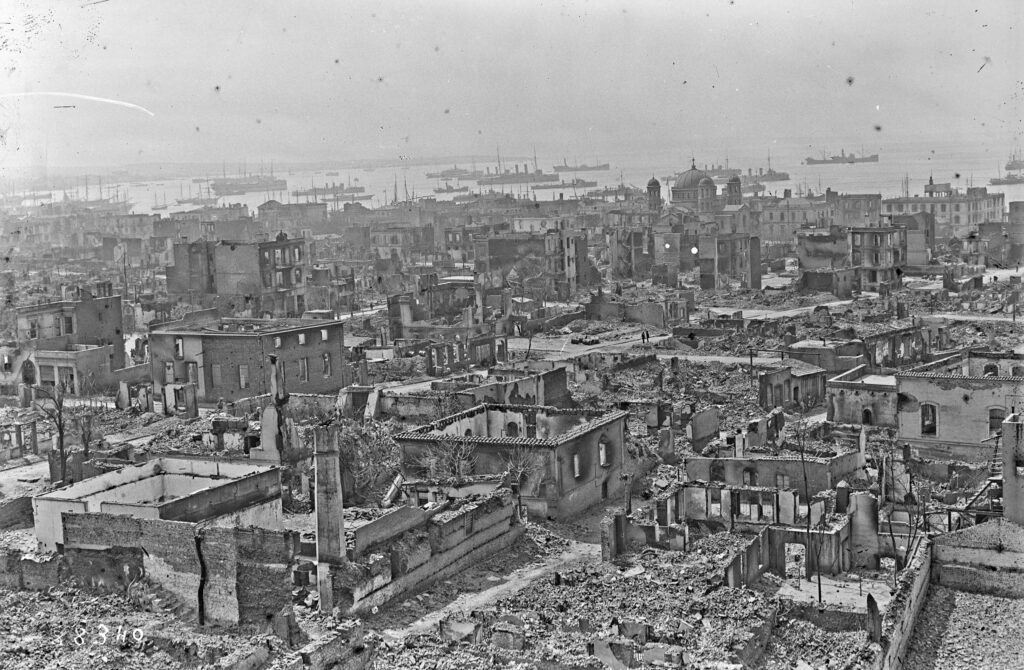
Agence Rol, Public domain, via Wikimedia Commons
Before the fire, Thessaloniki was not merely a Jewish city in demographic terms but a Jewish city in function. Under Ottoman rule, Jews dominated key sectors of the port economy, including dock labor, grain handling, tobacco processing, textiles, and food trade. Jewish workers, merchants, and artisans shaped the city’s daily rhythms. The port famously shut down on Shabbat because so many dockworkers were Jewish. This was a highly urban, highly organized community, deeply accustomed to markets, supply chains, and commercial food culture long before anyone imagined rebuilding those systems in Tel Aviv.
On August 18, 1917, a small kitchen fire in the Jewish quarter of Thessaloniki spiraled into one of the most devastating urban disasters in modern Greek history. Fanned by strong winds, the flames consumed the heart of the city over 32 hours, destroying 9,500 homes and leaving more than 70,000 people homeless. Among the displaced were approximately 53,000 Sephardic Jews, descendants of families who had found refuge in the Ottoman Empire after their expulsion from Spain in 1492.
For over four centuries, Thessaloniki had been the jewel of Sephardic Jewry, sometimes called the “Jerusalem of the Balkans.” The Jewish community had transformed the port city into a thriving center of Ladino culture, commerce, and religious scholarship. Jewish dock workers famously shut down the port on Shabbat. Ladino newspapers flourished. Synagogues numbered in the dozens, each serving families from different regions of the former Spanish kingdom.
The fire changed everything.
In a single weekend, centuries of accumulated community infrastructure, synagogues, schools, businesses, mutual aid societies, libraries, vanished in smoke. The disaster came at a particularly vulnerable moment. World War I raged across Europe. Economic instability gripped the region. And increasingly virulent nationalism was beginning to marginalize Jewish communities throughout the Balkans.
The Zionist Response: A Company is Born
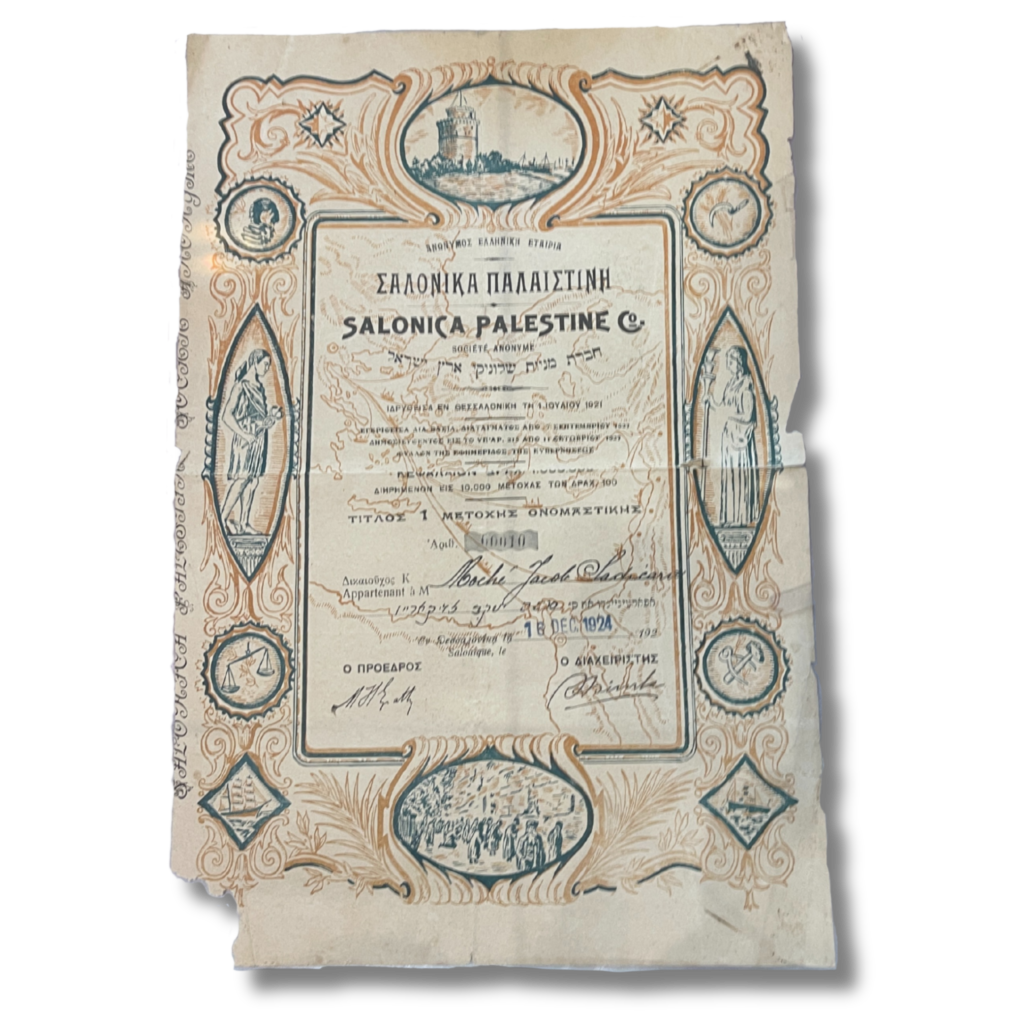
Among the ashes of the Great Fire, a group of 300 Zionists saw not just devastation, but possibility. In 1921, they founded the Salonika-Palestine Investment Company with a bold vision: to create commercial and agricultural ties between Thessaloniki’s Jewish community and the growing Jewish settlements in Palestine. The company would facilitate both trade and immigration, offering Sephardic Jews a pathway to rebuild their lives in the ancient homeland.
The timing was prescient. The situation for Jews in Thessaloniki continued to deteriorate throughout the 1920s. Greek nationalist policies increasingly excluded Jews from economic life. Antisemitic incidents rose. Many Sephardic families who had weathered the fire began to see their future elsewhere, whether in France, the Americas, or Palestine.
Finding Land: From Vision to Reality
In 1924, the Salonika-Palestine Investment Company sent an envoy to Palestine with a specific mission: find land suitable for establishing a new neighborhood that could absorb Greek Jewish immigrants. The envoy identified an area in Jaffa, south of Tel Aviv’s Herzl Street, bordering the neighborhoods of Neve Tzedek and Ahuzat Bayit. The location was strategic. It sat near the Jaffa Jerusalem railroad, between the Arab port city of Jaffa and the rapidly growing Jewish town of Tel Aviv, and fell within the shifting planning framework of the early British Mandate period, when new land registration systems and urban expansion made large scale neighborhood development possible, if uneven.
The land purchase marked the beginning of what would become the Florentin neighborhood, named after David Florentin, the leader of the Greek immigrant group who earned the affectionate nickname “David Palestina” for his pioneering work in establishing the new community.
But the visionary behind the land purchase and the driving force behind actual construction was another man entirely.
Solomon Florentin: The Contractor Who Built a Neighborhood
Solomon (Shlomo) Florentin was born in 1864 in Thessaloniki into a wealthy family whose roots stretched back to Florence, Italy, hence the surname. Over the years, Solomon had built considerable wealth working in insurance and tobacco, earning an important position within the Thessaloniki Jewish community and developing connections with Greek government officials.
Even before immigrating, Solomon had been investing in the Land of Israel. While still living in Greece, he purchased land in what would later become the Kiryat Shaul neighborhood north of Tel Aviv. When he finally made aliyah in 1924 at age 60, he came not as a refugee but as an entrepreneur with resources, connections, and a plan.
Together with other Thessaloniki merchants, Solomon initially attempted to establish an agricultural settlement in the Kiryat Shaul area. They built a water tower and tried farming. But the venture struggled, and Solomon soon turned his attention southward, to the land the Salonika-Palestine Investment Company had purchased near Jaffa.
Building for the Working Class
Life in the new neighborhood followed the rhythms of labor. Bakers rose before dawn. Metalworkers and carpenters worked six days a week. Shops closed early on Fridays as families prepared for Shabbat. This was not a residential suburb but a working ecosystem, where economic survival, religious life, and family routines were tightly interwoven.
Unlike many urban developers of the era who focused on building for the middle and upper classes, Solomon Florentin had a different vision. Working with his partner David Abarbanel and backed by the Salonika-Palestine Investment Company, he designed the neighborhood explicitly for low-to-middle-income immigrants, primarily Sephardic Jews from Jaffa and from Thessaloniki itself.
Construction began around 1927 to 1929, though Ottoman-era land-use laws had initially delayed development. Solomon’s architectural approach created a dense urban fabric that would come to define the neighborhood’s character: 3 to 4 story buildings with ground-floor workshops. This mixed-use design fostered an artisan culture where families lived above their places of work, bakeries, carpentry shops, metalworks, and eventually, the food stalls and delicatessens that would make the area famous.
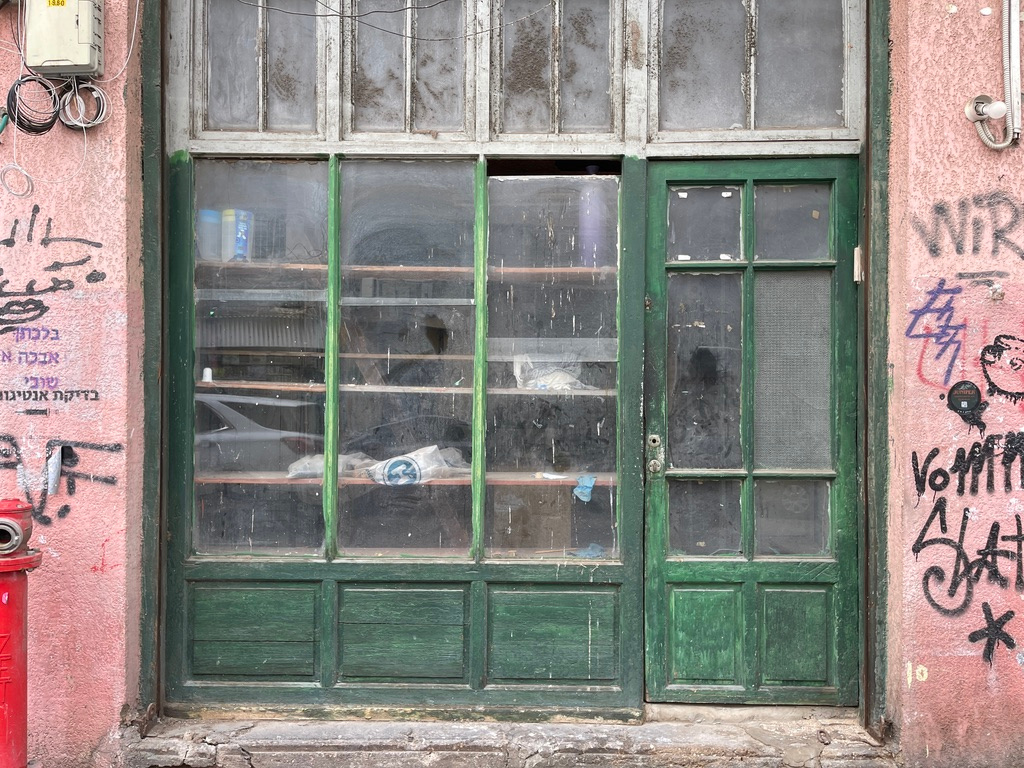
The neighborhood was designed for people who worked with their hands, who spoke Ladino at home, who remembered the mezze and coffee houses of Salonika, who needed affordable housing close to work opportunities in both Jaffa and Tel Aviv.
Solomon Florentin died in Tel Aviv in 1946, leaving behind three daughters and a son. By then, the neighborhood bearing his name had already begun its transformation into one of Tel Aviv’s most distinctive districts.
The Culinary Migration: Bringing Salonika’s Flavors to Levinsky
Alongside recipes, the immigrants brought a familiar pantry. Sesame seeds and tahini, cured olives, vine leaves, coffee roasted dark and ground fine, dried herbs, and preserved fish all traveled easily across the Mediterranean. These ingredients shaped what could be cooked, sold, and eaten, and they remain foundational to Levinsky Market stalls today, linking the market’s flavors directly to the kitchens of pre fire Thessaloniki.
The Greeks who settled in Florentin didn’t just bring their belongings, they brought their appetites, their recipes, and their food memories. And these they transplanted into the streets radiating from Levinsky Street, which ran along the northern edge of the Florentin neighborhood.
From the earliest days, these working-class Sephardic immigrants established food shops and delicatessens that recreated the tastes of home:
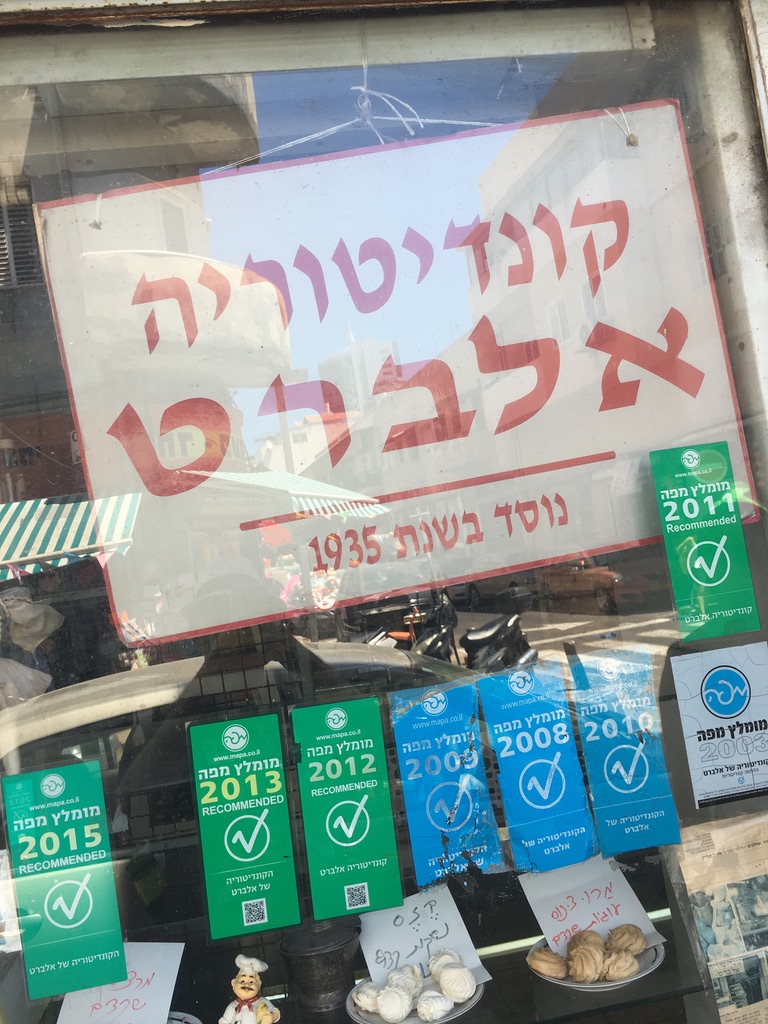
Konditoria Albert opened in 1935 on nearby Matalon Street, becoming Tel Aviv’s only Greek bakery. Albert Yehuda, from Salonika, specialized in handmade marzipan, meringue kisses (bizet), and marichinos, almond cookies made without flour. The family maintained old-world methods throughout their 84 years of operation, with elderly family members hand-shelling almonds at a table in the shop, refusing modern machinery until the bakery’s closure in July 2019.
Atlas Coffee, established in 1924, served as a gathering place where newcomers from Thessaloniki and Istanbul could find strong cafe shahor (black coffee) and freshly ground spices that reminded them of home. Founded by immigrants from Salonika, Atlas became known for healing herbal blends alongside coffee, selling dried leaves and roots for folk remedies. Today, run by David and Juliet Refaeli who acquired it approximately thirty years ago, Atlas stands as the oldest continuously operating business in the Levinsky Market area.
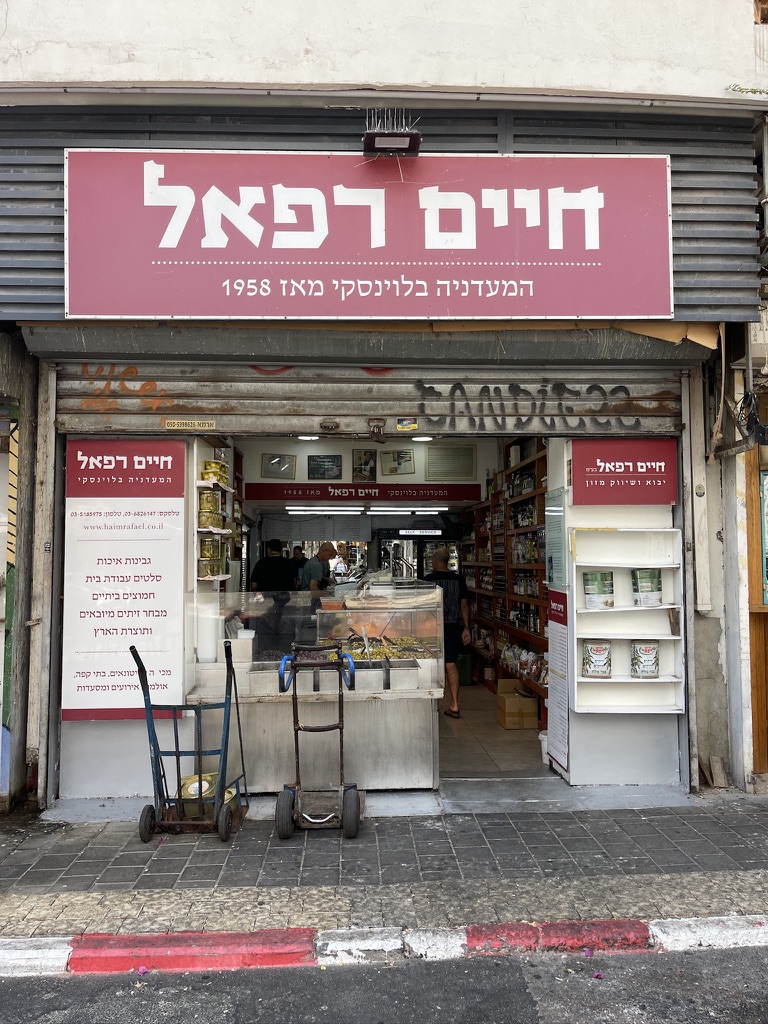
Haim Raphael Delicatessen, though founded in 1958, embodies the Salonikan culinary tradition. Haim Raphael was born in Thessaloniki in 1924 and survived Auschwitz-Birkenau as the only member of his family to escape the Holocaust. After arriving in Israel in 1946 on the illegal immigrant ship Haviva Reik, he and his wife Esther eventually opened their grocery store in Levinsky Market. The shop became renowned for traditional Greek and Turkish specialties: stuffed vine peppers with creamy cheese, his grandmother’s legendary tarama salad recipe, black olives prepared in the Salonikan style, and kiftikas (leek patties), dishes carrying the flavors of pre-war Thessaloniki’s Jewish quarter.
The Eliyahu HaNavi Synagogue: A Community Takes Root
The Sephardic community’s commitment to establishing permanent roots in the Levinsky area found expression in the Eliyahu HaNavi Synagogue, founded in the mid-1920s as a shared institutional home for the area’s diverse Sephardic population, including immigrants from Thessaloniki, Istanbul, Bulgaria, and long-established Sephardic families from Jaffa. Established through the Ezrat Holim association, the synagogue emerged from practical needs rather than symbolism, providing a nearby place of worship for artisans and shopkeepers working along Levinsky and its surrounding streets. Built on Levinsky 44 after a series of donations and land transactions, and designed by engineer Yehuda Magidovitch, it served approximately 150 regular worshippers by the 1930s and stood as a stabilizing communal anchor in a neighborhood shaped by migration, labor, and daily commerce.
The Salonikan Legacy Today
One reason Ladino survived longer in Levinsky than in many homes is that commerce preserves language. Words linger above counters and in transactions long after they fade from domestic use. Markets remember what living rooms forget.
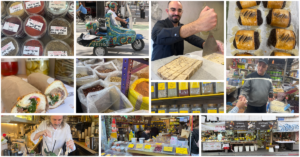
Walk through Levinsky Market today, and the Salonikan influence remains palpable, even as it has blended with later waves of immigration from Turkey, Iran, Yemen, and beyond. The hand-rolled bourekas echo the burekitas of Ottoman Thessaloniki. The strong coffee served in tiny cups recalls the kafeneia of the old Jewish quarter. The use of Ladino words, bizet for meringue kisses and tarama for fish roe salad, persists even among vendors born in Israel who never heard their grandparents speak Judeo-Spanish.
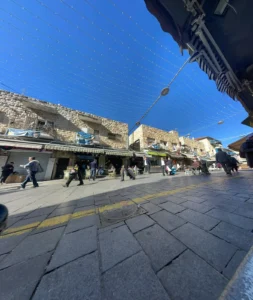
The architectural legacy of Solomon Florentin’s vision, dense, mixed-use buildings with ground-floor commerce, created the physical infrastructure that allowed the market to thrive. The narrow streets and human scale of the Florentin neighborhood proved ideal for pedestrian commerce, eventually leading to the official pedestrianization of Levinsky Street in 2022.
Yet the Salonikan connection carries a melancholic undertone. The vast majority of Thessaloniki’s Jews who remained in Greece, those who didn’t make it to Palestine, France, or the Americas in the 1920s and 1930s, were murdered in the Holocaust. The community that had flourished for four centuries and survived the Great Fire of 1917 was virtually annihilated between March and August 1943, when the Nazis deported over 45,000 Jews to Auschwitz-Birkenau. Only about 2,000 survived.
This makes places like Levinsky Market more than just a food destination. What survives here is not a complete culture but fragments held together by habit, repetition, and work. Continuity in Levinsky has always been partial, and that is precisely what makes it real. They are living archives of Sephardic culture, preserving recipes, preparation methods, and food traditions that were largely destroyed in Greece. When you bite into a hand-rolled boureka at Penso, you’re tasting a direct link to a vanished world. When you sip coffee at Atlas, you’re participating in a ritual that connects Jaffa Street to the lost kafeneia of Thessaloniki.
The closure of Konditoria Albert in July 2019, with the family refusing to sell or share their recipes and choosing instead to take the culinary secrets of pre-war Salonika into retirement, symbolized both the fragility and the dignity of this cultural transmission. Some traditions must end. But others, maintained by families who still remember or who learned from those who remember, continue to infuse Levinsky Market with the flavors of a city across the sea.
Ladino Lives On
Today, more than a century after the first Salonika immigrants arrived, their language still graces Levinsky’s storefronts. At Atliz Mercaz Levinsky (34 Levinsky Street), the butcher shop run by Menachem Okunis, a traditional Ladino proverb is prominently displayed.
“Cuando el Dios está contigo, no te espantes de tu enemigo”
(When God is with you, do not fear your enemy)
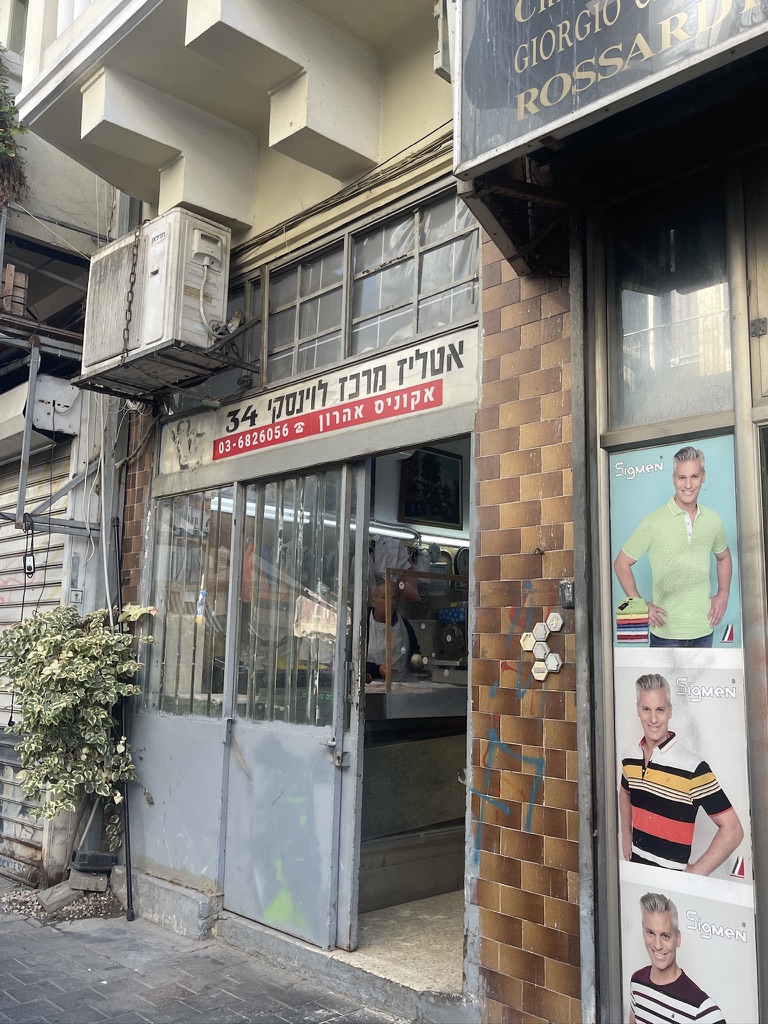
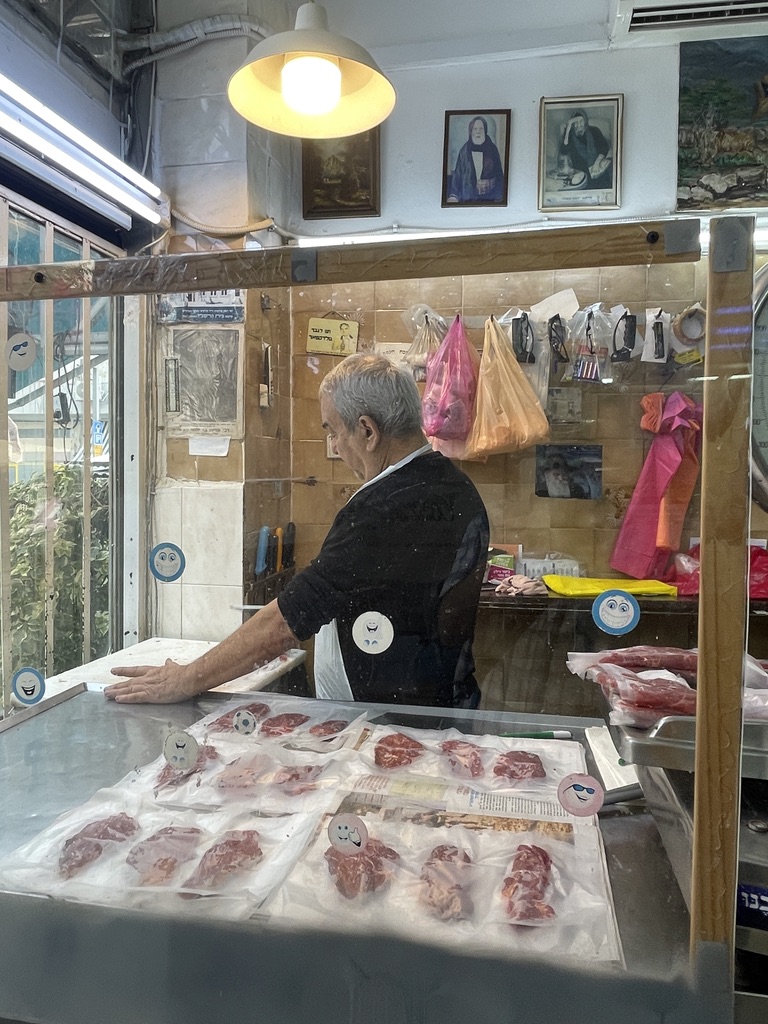
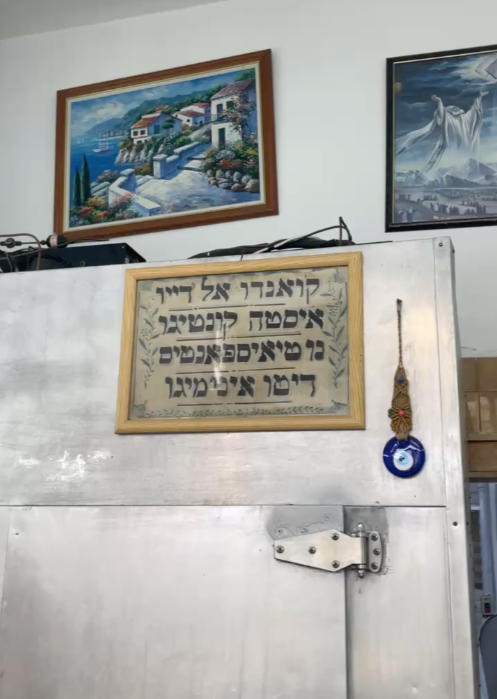
This is not a museum piece or historical curiosity. It is a living expression of faith, displayed in the language carried from Thessaloniki and Istanbul, reminding customers that Levinsky Market is not merely a commercial space but a living archive of Sephardic Jewish experience.
Okunis himself represents the generational continuity that defines the market. As a second-generation vendor, he watched Levinsky transform through the gentrification of the 2010s with what he described as “a bit of sadness, a bit of acceptance, from someone who understood there’s nothing to be done against the changing times.”
Seen through this lens, the Ladino sign above his butcher counter takes on additional weight. Sephardic Jews expelled from Spain in 1492, refugees of the Thessaloniki fire of 1917, Holocaust survivors rebuilding after 1945. All are compressed into a single sentence written above a meat counter on Levinsky Street. The proverb is not decorative. It is autobiographical.
A Market Built from Memory
Understanding the Salonika connection transforms how you experience Levinsky Market. What might appear as simply Mediterranean food or Israeli cuisine reveals itself as something more specific and more poignant: a displaced community’s successful effort to rebuild not just their lives, but their entire sensory world in a new land.
Solomon Florentin’s vision of a neighborhood for working-class Sephardic immigrants created the conditions for this cultural preservation. By building affordable, mixed-use spaces, he enabled families to establish food businesses that could survive across generations. By clustering immigrants from similar backgrounds in one area, he fostered the critical mass necessary for specialized food shops to thrive.
The neighborhood he built became a bridge, connecting Sephardic Jewish traditions to the emerging Israeli culture while maintaining distinctiveness and contributing to the broader mosaic of Tel Aviv’s development. Today, as Florentin gentrifies and Levinsky Market attracts hipster coffee shops alongside century-old spice vendors, that bridge remains visible, walked daily by residents and visitors who may or may not know the story of how a fire in Thessaloniki in 1917 ultimately shaped where they buy their morning coffee in 2025.
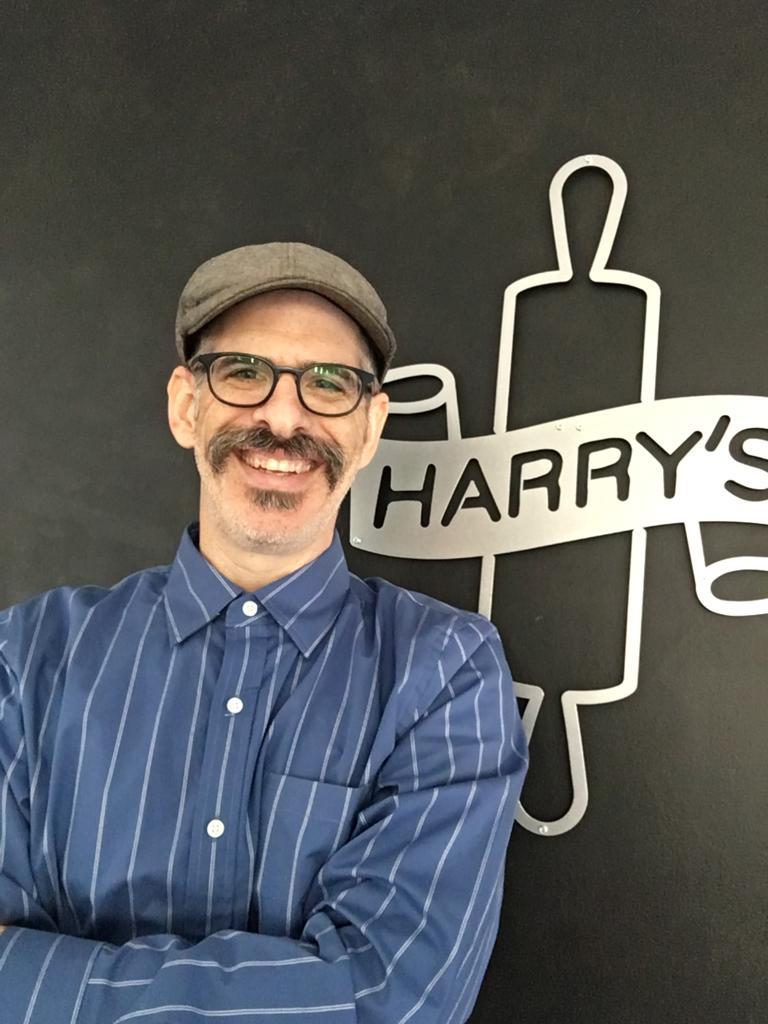
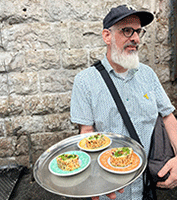
Harry Rubenstein is a pastry chef, food writer, and food tour guide based in Israel. A graduate of Bishulim Culinary Institute, he leads private food tours through Mahane Yehuda in Jerusalem and Levinsky Market in Tel Aviv. His writing on Jewish food history appears in The Nosher.
Read more about Harry →Taste Levinsky Market for yourself
Want to explore the flavors, stories, and hidden corners of Levinsky Market with a local guide? Book a private Levinsky Market food tour and eat your way through Tel Aviv’s most iconic food street.
More from Levinsky Market